Happy Feet and Sikhi!
by MANPREET KAUR SINGH
 If you want to begin a conversation about Sikhism with a child and don’t quite know where to start, just go to the cinema and watch "Happy Feet".
I think Mumble - the central character of the animated movie - is the ideal Sikh, and someone all kids should strive to be. He is different from the rest; and not just that, he is proud to be different. He doesn’t want to follow the pack, even under immense peer pressure. More than that, he is always happy, even when up against heavy odds; moreover, he gallantly risks his life to save the colony - demonstrating the concept of “sarbat da bhalla”, as embodied in Sikhism. Although the movie is primarily a love story, you don’t have to look too deep to discern the real message.
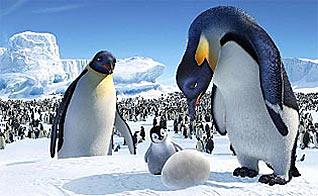

If you haven’t watched the movie yet, Happy Feet is an enchanting musical about a penguin colony, where everyone is a singer….or at least tries to be one. But Mumble is different, because he can only tap dance! Even though no one appreciates his dancing, he keeps at it, and feels happiest just being himself. His singing is woeful, but he doesn’t let the sneers and jeers bother him. He finds friends who like his dancing, but the elders of the colony perceive him as a threat - because he questions the established norms and the pack mentality. They blame him for the depleting stock of fish in the water because of which the colony is slowly but surely dying.
Mumble is given the choice to conform and stay within the colony or leave his family forever and go with his friends. He refuses to buckle under the pressure, and chooses the latter. Even though he is ostracized, Mumble vows to find out why there aren't enough fish in the water anymore and he goes to live in another colony.
There, he questions the local demigod, ‘Lovelace’, and sees through his charade, realizing that Lovelace couldn’t really “predict the future” as he claimed, but people worship him merely because he has something strange around his neck. It pans out later that it is a plastic six-pack can-holder (from polluting flotsam and jetsam) which is also slowly choking Lovelace to death.
Mumble sets out to help Lovelace and also to figure out the fish conundrum. His friends accompany him on a dangerous journey and finally they are able to cut the plastic stuck around Lovelace’s neck. Having set him free, Mumble leaves him and his friends to embark on a risky mission alone.

He follows the strange monster in the sea (a fishing ship, using nets to catch fish) to check if that is what causes the fish to disappear. In the process, he himself is caught in the net and is placed in a zoo - for humans to admire a ‘live Antarctica exhibit’. Despite the circumstances, when everyone around him is losing their sanity, Mumble hangs in …and begins to tap dance!
Suddenly everyone notices him and the humans feel that the tap dancing penguin is trying to communicate with them - and give them a message. In the end, he leads the humans to his penguin colony and under immense pressure from the media, governments world-wide ban fishing ships in the area.
So Mumble, keeping his head - and his ways - saves the whole of his colony, which lives happily ever after….. Isn’t he just the perfect example of what a Sikh should be – full of self-belief, not daunted by anyone, not succumbing to any pressure, questioning heresy, living happily in adversity and above all, risking his own life for the greater good of all? Perhaps the only thing he is missing is a patka!!
Well, Mumble Singh, thanks for telling us what we should be – let's hope more of us can dare to be different like you……..and proudly so!
Footnote for all the Sikh men: The movie shows female penguins going to sea, to catch fish for the family, while the men stay at home to look after the eggs and the babies in the nest. Can we extend the metaphor to our men as well……please?
http://sikhchic.com/article-detail.php?id=104&cat=2
Footnote for all the Sikh men: The movie shows female penguins going to sea, to catch fish for the family, while the men stay at home to look after the eggs and the babies in the nest. Can we extend the metaphor to our men as well……please?
http://sikhchic.com/article-detail.php?id=104&cat=2
Comments