“………….but I want to do what I want to do”. The loud voice of ‘once’ sweet son, came from the family room as I asked him to turn the TV off and ‘practice’ that he learns after school and on weekends. I was not only shocked but almost in tears as this was not my same son who religiously followed the evening routine and took everything seriously that he learnt in extra curricular activities, along with his learning at school. Above all that he has been ‘Mama’s helper’ in tutoring his younger sister, passing on all the good stuff that he learnt to his sisters. Like his first-grade teacher still says about him "They don't come in better package than this one". I had no complaints and said prayer of gratitude for these children every morning and before going to bed. But what happened this last week? I don’t know except that I know he is going to celebrate his 12 th birthday in few weeks and he is growing. I think that is what they call adolescence. If I remember it right it is...
Comments
Vahiguru Ji Ki Phatah,
Sikh Missionary College has published many intriguing, thought provoking yet inspirational pieces like this.
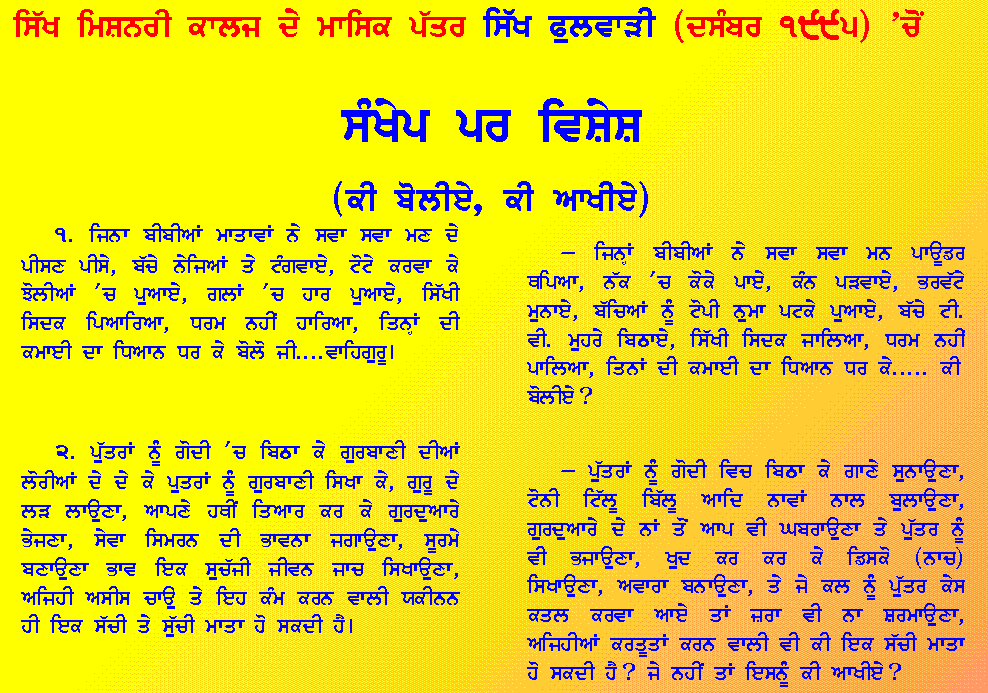
Their rendition of the positive definition of a Gursikh mother is quite accurate. The only way to inculcate an instinctive relationship with the Guru is through the osmosis of motherly upbringing. As the mother will do, so will the child.
However, wouldn't the message be even more powerful if rather than only "putar" the poster also mentioned "putari" or "beti". If Sikh mothers do not inculcate seva-simran and sant-sipahi aspects in our Sikh girls and women right from the beginning as well, how will the future generation of mothers have the strength and personality to pass on Sikhi to the children.
Conversely, what about the responsibility of the fathers? What roles did Gursikh fathers play in the upbringing of fine Sikh children. I have not found explicit articulation of their roles in our books and historical texts but I am sure they had an equal part to play.
We must somehow make balance the roles of mother and father, daughter and son in our Sikh families. A very tall order in the midst of both an archaic patriachical Panjabi cultural context as well as a warped western concept of liberalism.
Thought I would share, I relish your blog topics.
Carhdi kala!
Inderpreet ji, thank you for taking the time to read my post and leaving your thoughts. I do agree with you completely that mention of mothers and sons is not enough here; fathers should and in most cases do play equal role in upbringing of a Sikh child (son or daughter). A woman alone can’t raise Sikh children without a Sikh husband to support her and as a role model for her children. Even though much emphasis is not given in the historical texts, but we find many examples through out sikh history that fathers/males contributed to the upbringing of Sikhs/Warriors. Guru HarGobind Sahib ji was entrusted to Bhai Buddha Ji for his education of offensive and defensive weapons and other areas of education. Another example comes to mind from Sikh misls of Nawab Kapur singh who adopted and trained Jassa Singh Ahluwalia who later took over the leadership of sikhs after him. We can't forget our Great Guru Gobind Singh ji who not only trained Sahibjaade in Miri-piri but also sent both Baba Ajit and Baba Jujhar Singh in battle of Chamkor to fight the mughals.
Your examples of fatherly (or male) nurturing of Sikhi ideals is indeed correct and noteworthy.
Speaking about Sardar Jassa Singh Ahluvalia, it is a very rare known fact that he was a kirtani par excellence. Even rare is the fact that he learnt kirtan from his mother. Both of them used to render kirtan in the darbar of Mata Sundari in Delhi. It was precisely young Jassa Singh's kirtan/gurmat sangit skills that attracted Navab Kapur Singh to the young boy and he took him under his wings.
But for the life of me I have not been able to find out of all our texts the "name of Sardar Jassa Singh Ahluvalia's mother"!! Any help would be appreciated.
Carhdi Kala!
Thanks again,
Guru Raakha!
Thanks for sharing!!