Compassion for poor and suffering

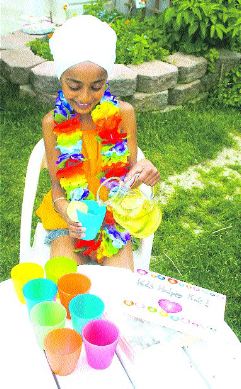
Young Sikh Girl raises money for Canadian Red Cross

Few children make a point of catching the latest edition of World Vision on television. For most kids, the dire circumstances of others their age living without food, water and shelter, and suffering the horrifying effects of AIDS, in the Third-World nations, don't register.

But Japnaam Kaur isn't like other children.

Since age four or five, she has asked her parents to choose channels that are playing World Vision when they sit down to watch TV.

And once the program ends, she always says the same thing: "I want to help them."

With the help of her parents, her school and other children in her neighbourhood, the seven-year-old set up a lemonade stand and recently raised $290 for the Canadian Red Cross.

"I wanted to raise money so that those children can have food, and so that not a lot of people will die from AIDS anymore," Japnaam said.

But she never imagined that her little lemonade stand, along with other stands some friends set up in support of Japnaam's efforts, would be such a hit.

"We sent notes home with kids at Lester B. Pearson school and St. Luke school, asking other people to help out," Japnaam said. "But I only thought we'd make about $50."

Mother Nature had other ideas. A hot, sunny Saturday recently enabled the children to collect boxes upon boxes full of coins.

"We charged 25 cents or a donation," Japnaam said. "One person liked the lemonade so much they had five cups."

It was a lesson for all the children who helped out that day-- as well as some adults.

"We are so proud of Japnaam," said her mother, Sukh. "This is something she's wanted to do for a long time - every summer she's become more and more determined."

Sukh also enjoyed watching her daughter learn what it takes to put a plan in motion.

"You could see every brain wave - like when she figured out that the more people she could get to help, the more money they would raise," Sukh said. "It was amazing to see her make that connection."

And when the sale was over and it was time to count the donations, Japnaam came up with a little routine.

"After she counted each coin she said thank you," Sukh said. "She realized that every little quarter made up such a big pot, and she was grateful for that."

Sukh explained that she and her husband have stressed to Japnaam how lucky she is to be in Canada.

Japnaam's father was a refugee from India 20 years ago, and witnessed the death of countless Sikhs in India.

"We haven't sheltered her from that," Sukh explained. "We've taught her to never turn a blind eye to others' pain."

And that's a lesson Japnaam thinks of every day.

"The people in Africa work a lot harder than we do and all they have is a small hut," she said. "We have big houses and they have nothing.

"I do a little prayer for them every night."

Comments

Jaswinder Singh said…
very nice!

Popular posts from this blog

Uh jo chhote han na vaade

“………….but I want to do what I want to do”. The loud voice of ‘once’ sweet son, came from the family room as I asked him to turn the TV off and ‘practice’ that he learns after school and on weekends. I was not only shocked but almost in tears as this was not my same son who religiously followed the evening routine and took everything seriously that he learnt in extra curricular activities, along with his learning at school. Above all that he has been ‘Mama’s helper’ in tutoring his younger sister, passing on all the good stuff that he learnt to his sisters. Like his first-grade teacher still says about him "They don't come in better package than this one". I had no complaints and said prayer of gratitude for these children every morning and before going to bed. But what happened this last week? I don’t know except that I know he is going to celebrate his 12 th birthday in few weeks and he is growing. I think that is what they call adolescence. If I remember it right it is...

The Punjabi Garden - By Patricia Klindienst

Patricia Klindienst is a master gardener and an award-winning scholar and teacher. She lives in Guilford, Connecticut, and teaches creative writing each summer at Yale University. Excerpted from The Earth Knows My Name: Food, Culture, and Sustainability in the Gardens of Ethnic America, by Patricia Klindienst. Copyright © 2006 by Patricia Klindienst. ---------------------------------------------------------------------------------------------------------------- A California gardener used the farming wisdom of her native India to create a suburban paradise that restored her soil--and sustains her soul. “I told my father, ‘I will be poorer in America, but my conscience will be free.’” I write the words on a paper napkin and turn it to face her. “Is this right? Is this what you just said?” “Yes. I did not come to America to trade my cultural heritage for money.” I take the napkin back and write the second sentence as well. Her words are so striking that I do not want to rely on memory al...

Violence against women: How Anger Destroys Families and What Gurbani Teaches Us

Note to the readers: I wrote this in 2009 and kept it tucked away. Coming back to it reminded me why I wrote it in the first place, and I’m glad to finally share it. November 25th is the international Day for the elimination of violence against women. This day was recognized by the General Assembly of United Nations in 1999 with a view too raising public awareness of violations of the rights of the women, why was this step deemed necessary? In many cultures women are viewed and treated as inferior or as second class citizens. Prejudices against them are deep rooted. Gender based violence is an on going problem even in the so-called developed world. According to former UN Secretary General Kofi Annan “Violence against women is global in reach, and takes place in all societies and cultures,” he said in a statement marking the International Day for the Elimination of Violence against Women. “It affects women no matter what their race, ethnicity, social origin, birth or other status may...